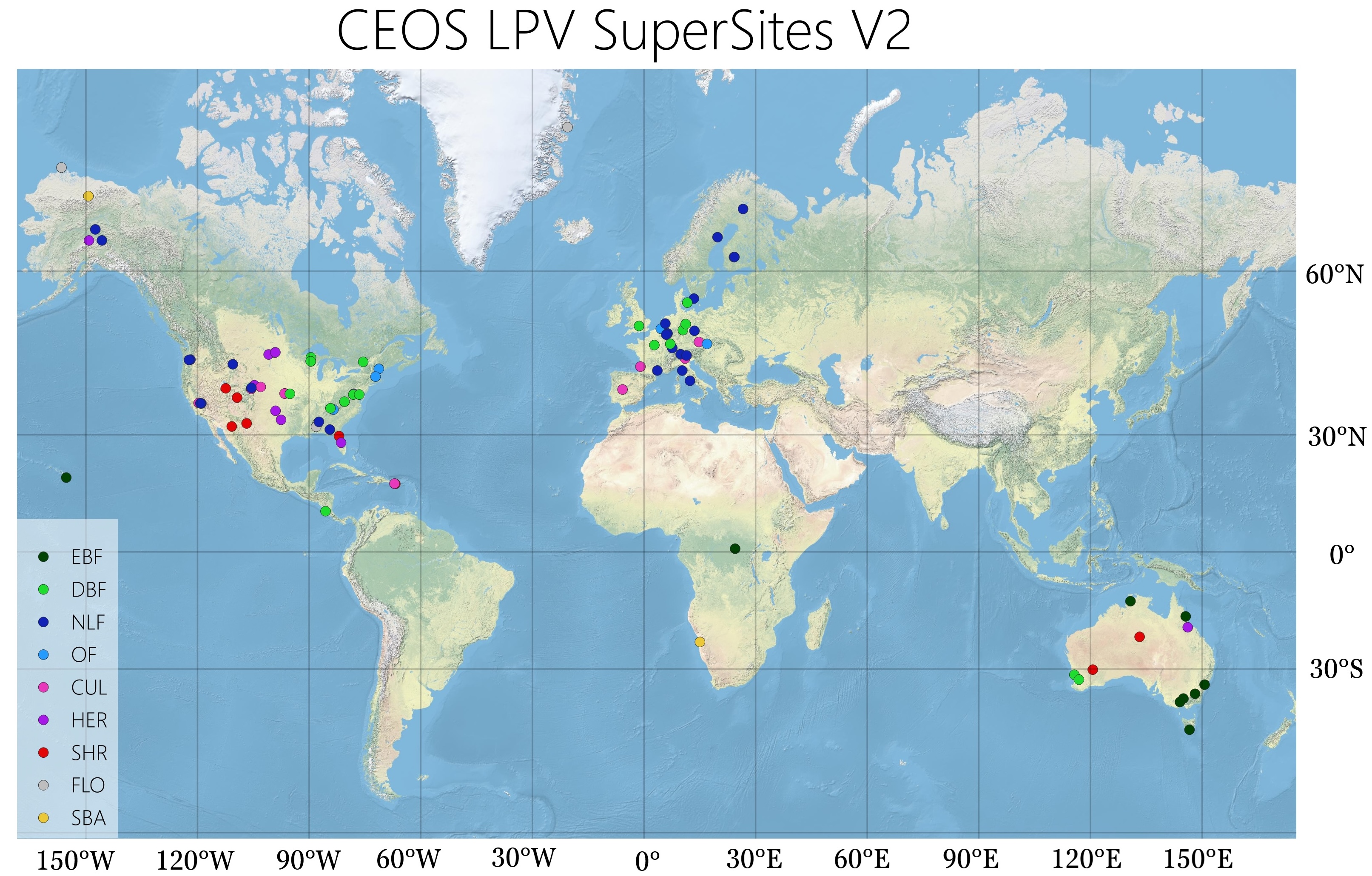

LPV Supersites V2
CEOS Land Validation Sites
The LPV Supersites were established first in 2016, championed by Fernando Camacho (then LPV vice-chair), with the purpose of enhancing the quality of Cal/Val reference data. Over time, the LPV subgroup elaborated the concept of a supersite to include:
- Super-characterized (canopy structure and biogeophysical variables) site following well-established selection protocols, that is useful for the validation of satellite land products (3 product families) as well as radiative transfer modeling approaches
- Active, long-term operations, supported by appropriate funding
- Supported by airborne/UAV LiDAR and hyperspectral acquisitions (desirable)
- Adherence to CEOS FRM principles (desirable)
Since the initial selection of sites in 2016, the satellite product landscape has evolved significantly, with new Cal/Val initiatives and sites emerging, as well as advanced satellite sensors on the horizon. To ensure an up-to-date representation of land global validation capacity and to effectively support expanding validation needs, a comprehensive review of the LPV Supersites was undertaken in 2025, performed by Fernando and the EOLab.
A total of 230 sites were evaluated, including all current supersites, as well as many new candidates from ecosystem monitoring networks (NEON, ICOS, and TERN) and other initiatives (e.g., GBOV, HYPERNETS). The selection criteria was built upon the previous set, further extending criteria to include spatial homogeneity, the availability of UAV-based facilities, and adherence to FRM principles. The selection process resulted in 91 new supersites, with an additional 65 candidates that are close to the cutoff threshold that have been retained for future consideration.
A summary of the site selection process for the recent V2 update is detailed in this report.
Details for the final set of selected sites are available in this spreadsheet.